
Garment Factory Protests Stalls Production in Bangladesh as Workers Demand Higher Wages
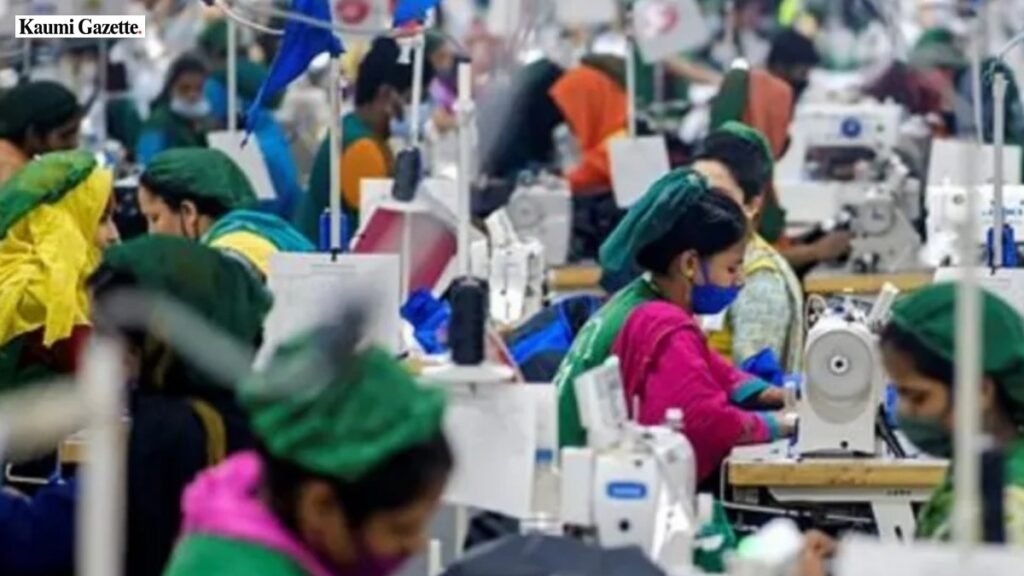
NEW DELHI — Production has stalled across nearly 700 readymade garment factories in the Bangladeshi industrial hubs of Gazipur and Ashulia, as thousands of workers take to the streets alongside demonstrations in Dhaka to demand steep wage hikes.
The nationwide garment sector generated close to $39 billion in the 2025–26 financial year, serving as the financial backbone of Bangladesh’s export economy. Accounting for roughly 80% of total export revenue and employing upward of four million people, the industry built its global standing as the world’s second-largest apparel exporter behind China largely on the back of unmatchably cheap labor.
Protesting workers are demanding an increase in the minimum monthly wage to 30,000 taka, equivalent to about $242, which marks a 2.4-fold rise from the current baseline of 12,500 taka. That previous floor was established in late 2023 following a prior round of labor unrest. According to the Bangladesh Bureau of Statistics, point-to-point inflation hit 8.34% in September 2026, up from 8.26% in August, with food inflation at 7.2% and non-food inflation climbing to 9.3%. Wage growth has lagged behind at 7.9%.
A former director of sourcing for fashion brand Zara told The Indian Express that the labor action exploits a critical window because November and December represent peak order months for Western consumption. Given the labor-intensive nature of garment production, where it takes roughly 65 workers per day to manufacture items like a T-shirt, the time-sensitive schedules place intense leverage on factory management.
Local manufacturers operate within tight margins governed by international buyers who demand strict delivery schedules. Missing these deadlines forces owners to either keep products themselves or ship by air freight, which eliminates profit margins entirely.
Energy shortages compound these manufacturing pressures. Domestic natural gas output has fallen from 2.7 billion cubic feet per day to 1.7 bcf, reflecting a roughly 33% decline in domestic extraction noted in 2025 by the Bangladeshi news outlet Prothom Alo. While imported liquefied natural gas serves as a stop-gap measure under rationing, water- and oil-intensive garment factories face unyielding procurement contracts signed months in advance.
The prolonged shutdowns threaten Bangladesh’s foreign exchange reserves, which have dwindled to $34.85 billion, alongside national currency strength and domestic consumption. Selim Raihan, a professor of economics at the University of Dhaka, told Reuters that factories could absorb higher wages without forfeiting competitiveness by boosting productivity. Treating cheap labor as a permanent strategy is a mistake, Raihan said, noting that Bangladesh must pivot toward reliability, productivity, and higher-value goods.
In an effort to defuse the crisis, the Bangladeshi government has reconvened its Minimum Wage Board to establish a revised pay structure starting in December.
The turmoil opens a strategic window for regional rivals like India, which is currently the world’s sixth-largest apparel exporter. India commands a distinct advantage through its comprehensive domestic supply chain and robust production of cotton and yarn.
Additionally, India stands to gain from recent Free Trade Agreements with the European Union and the United Kingdom that secure zero-duty market access for RMGs, cotton, man-made fibres, and silk. These trade pacts arrive as Bangladesh’s Least Developed Country classification approaches expiration, which will subject its garments to standard import tariffs between 9.6% and 12% and shrink the historical pricing gap that favored Dhaka.
Related stories
More from Analysis
 ExplainerDemocrats capture Congress as voter backlash over Iran conflict reshapes United States politics
 HeadlinesElection Commission directs fresh opportunity for omitted voters amid opposition criticism
 HeadlinesDemocrats Secure Control of Congress in 2026 Midterm Elections
 HeadlinesDemocrats win control of US Congress in midterm elections as Trump cites war on Iran
 HeadlinesElection Commission initiates voter enrolment drive across Uttar Pradesh
 OpinionRight to Vote Vs Right to Rule