
Right to Vote Vs Right to Rule
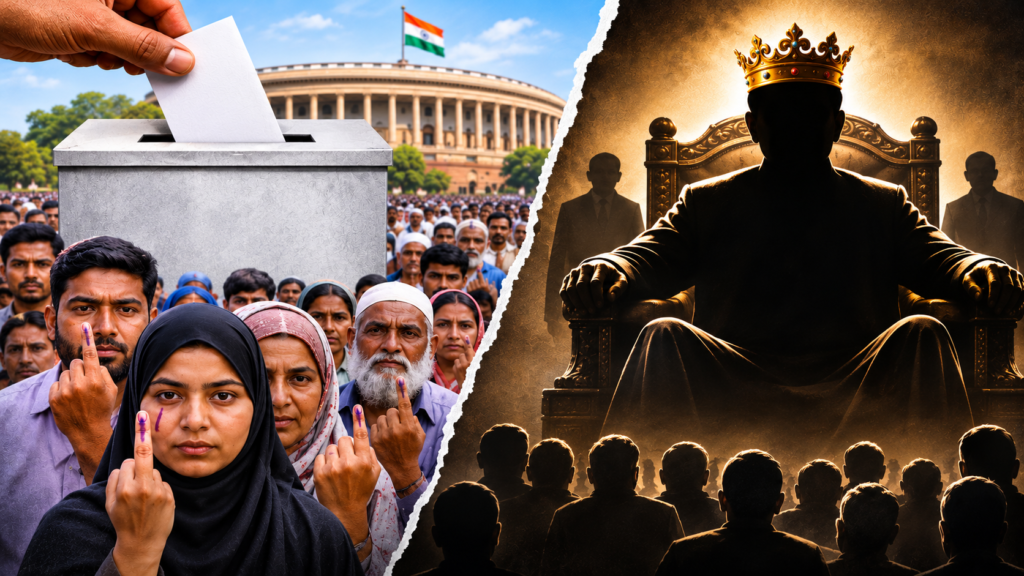
ELECTION results in the Knesset of Israel, a small country with barely ten million people and an electorate of approximately 7.3 million, are now out. The entire world is watching, not merely the outcome but also the ensuing struggle to form a government. Never before have Israeli elections attracted such intense international scrutiny. Global media coverage is relentless. Political analysts and intellectuals are debating the results, while world leaders are closely monitoring every development.
A pertinent question arises as to why elections in such a small country have attracted such extraordinary attention. There seem to be two principal reasons.
The first is the West Asian crisis, largely precipitated by Israel and its principal ally, the United States. Together, they have plunged the entire region into a devastating conflict. The incumbent Israeli leadership has presided over appalling brutality, oppression and human devastation. Its actions have set some of the darkest precedents in known human history. Prime Minister Benjamin Netanyahu is a declared war criminal by the International Criminal Court. He also faces corruption allegations at home and repeated charges of misusing the military and security agencies to preserve his political survival.
The second reason is more significant. Palestinian Arabs, Israel’s largest minority, have secured an electoral victory of such magnitude that no democratic government can now be formed without considering their political participation. Failure to reach an agreement could invite another election.
Muslims have participated in Israeli elections in substantial numbers since the state’s establishment in line with an unprecedented overall national polling turnout of around 78%. They have voted for their own parties and elected their representatives. They could repeat, or even strengthen, their present electoral performance if another contest is warranted. Israeli politicians recognise this possibility and anticipate a broadly similar outcome.
This has raised eyebrows and an extraordinary perturbation within Israel and sections of the international community, analysing irrelevant, nonfactual factors, concluding how Muslims have voted in such overwhelming numbers? Why have so many Muslim candidates won when Muslims constitute only 21 per cent of the population and have received no or minimal support from Jewish voters? They won in such a manner that, without their alignment, no political establishment can stand in Israel and neglecting their strength may force Israel into another election. Still, no alliance has yet indicated allegiance to the Arab bloc.
Minorities in Governance
Here lies the fundamental democratic question: If a minority enjoys equal citizenship and constitutional rights, including the right to vote and contest elections, how can its participation in governance be denied? Is it simply because they are ideologically different?
Neither of Israel’s two principal political blocs appears willing to accommodate Arab representatives in government formation. Both had promised their electorates during the campaign that they would not enter into any arrangement with Muslim parties. Yet removing Netanyahu, another potential promise made by the opposition bloc, has become virtually impossible without precisely such an arrangement.
Some sections of the electorate and certain political parties now favour an understanding with elected Arab representatives. The Muslim leadership, too, has indicated its willingness to go to considerable lengths to remove Netanyahu from power.
Arab blocs have already announced that the motion of no confidence seeking the Speaker’s removal after the swearing-in ceremony on 10 November can be passed easily by their vote. Similarly, controversial legislative provisions could also be amended with their support. Government formation may be taken up afterwards. Muslim parties have made their position clear: they are prepared to support the anti-Netanyahu bloc without necessarily joining the government.
This is despite the hard-line positions of both Israeli blocs. Both oppose the two-state solution and support policies that have led to the mass killing of Arabs and Palestinians. Yet Israel’s Muslims appear willing to make this limited political accommodation to oppose Netanyahu. Such an arrangement could bring a leader like Netanyahu within the reach of the law, pushing him behind bars and potentially holding him accountable for his actions.
Israel’s Muslims may have to compromise on various core issues due to compelling local circumstances to adopt a long-term political strategy. Their electoral achievement, however, placed an important question before the global community: If citizens possess the constitutional right to vote, how can their right to govern be denied? This is not merely an Israeli dilemma. It confronts democracies across the world.
Consider the United States. Barack Hussein Obama’s election as President provoked considerable resentment in sections of American society. His identity as a Black American Muslim, coupled with his Muslim family tree, became a source of hostility. The resentment grew so intense that Obama eventually was compelled to publicly distance himself from the name “Hussein”. Yet his election and personal background brought no discernible change in America’s anti-Muslim policy orientation.
Sadiq Khan, Zohran Mamdani, et al
Sadiq Khan’s experience in London offers another example. Since 2016 to date, he has secured three successive mandates as London Mayor. Yet his victories have repeatedly attracted vitriolic and aggressive criticism. Zohran Mamdani’s election as Mayor of New York, one of America’s most consequential metropolitan centres, has similarly encountered considerable hostility.
Approximately eleven American cities, including cities in Michigan and New Jersey, have Muslim mayors. Five Muslim representatives also serve in the US Congress. All face persistent political hostility. Ilhan Omar is perhaps the most prominent example. Abubakr Al-Sayed in Mississippi is now encountering a similar pattern.
The same contradiction exists elsewhere. Muslims in all secular democratic countries enjoy constitutional rights to vote and contest elections. Many have secured parliamentary representation without provoking widespread controversy. Resistance, however, intensifies when they aspire to executive office and actual political power.
Singapore is perhaps the only exception where it has had Muslim Presidents twice and Muslim Speakers of Parliament twice, without any public controversy. Across much of the ostensibly secular democratic world, however, the pattern remains remarkably similar.
Let us now turn to India.
Official demographic figures put the Muslim population at approximately 17 per cent, representing nearly 200 million voters. Yet Muslims occupy barely three per cent of parliamentary seats. Since Independence, their representation has never exceeded five per cent, barring once in 1980 when it was around 9%. While reaching the office of Prime Minister is almost impossible for a Muslim, although constitutionally there is no bar, Muslims have rarely been allowed to occupy even the office of Chief Minister. Abdul Ghafoor in Bihar, A R Antulay in Maharashtra and Syeda Anwara Taimur in Assam did become Chief Ministers for brief stints. Their elevation generated such political hooliganism and they were eventually forced to demit office.
The Indian Context
Political parties across India have consistently and deliberately sought to restrict Muslim representation to the barest minimum.
Consider the 90 Lok Sabha constituencies where Muslim candidates could comfortably win by consolidating their votes along with the other secular votes. While the BJP does not even consider giving Muslims their party candidature to send an unmistakable message to its Hindu vote bank, it represents an exclusively Hindu political party capable of suppressing Muslims; even ostensibly secular parties such as the Congress rarely allocate more than 40-45 tickets to Muslims.
The same pattern prevails in state legislatures. Akhilesh Yadav, for instance, allocates no more than 45 tickets to Muslim candidates out of approximately 400 constituencies in Uttar Pradesh. This is despite nearly 150 constituencies where Muslim candidates could win on a secular party ticket by consolidating support across other secular votes. It clearly indicates that their non-Muslim vote bank also doesn’t vote for a Muslim candidate.
Every state’s demographic and electoral figures are readily available. Political leaders also know them. These figures have repeatedly been brought to their attention by selfless and independent Muslim scholars and political brains. Yet those Muslim leaders who raise these issues, despite their known secular credentials, are treated as political untouchables by these same secular parties.
Political parties deliberately distance themselves from politically conscious and committed Muslim leadership. Instead, they favour opportunists, politically uninformed individuals and nouveau riche elements who are easier to accommodate with their anti-community whims.
The reason is obvious. Politically astute Muslim representatives would defend their community’s constitutional, democratic and secular rights with greater determination. More importantly, they could emerge as stakeholders in political power and governance.
That prospect is resisted not only in India but across much of the world. Political establishments want Muslim votes, currency notes and collective strength. They do not want to share power. They welcome Muslim support but for free, without sharing any political power.
In fact, the survival of secular politics in India still rests entirely on the Muslim resources and vote strength.
Muslims Want Legitimate Share in Power
Since the collapse of the Ottoman Caliphate, this pattern has persisted across the world. Earlier, however, it was less clearly understood because Muslim societies were themselves in a condition of shock and trauma due to the political consequences of that historical rupture, but today, this democratic deficit is becoming apparently palpable and hence intolerable. Muslims increasingly demand more than electoral participation. They seek political representation and a legitimate share in power.
Zohran Mamdani made this distinction clear during his election campaign. He openly asserted his Muslim identity and contested the election without concealing it. He subsequently emerged victorious.
Muslims in India and elsewhere must recognise a fundamental reality of a change in multiparty democracy. Two competing political blocs may differ in their ideological intensity, but they can converge when Muslim political empowerment is at the fore.
The United States ‘ two-party democracy and Israel’s two-bloc politics offer striking illustrations. One bloc may be more hard-line, the other relatively moderate. The Indian multiparty democracy is also divided into two blocs, i.e. hard-line Hindutva and soft Hindutva, though the latter describes itself as secular. Yet both refuse Muslim political participation and empowerment.
The consequence is the progressive silencing of minorities and other historically marginalised communities. Their political space shrinks. Their voices are marginalised. Their constitutional rights become increasingly vulnerable to exclusion and oppression.
In my previous article, I highlighted this very political confrontation in India. I see only one possible remedy: the resolute consolidation of a third political front, led by Muslim leadership in alliance with other deprived and marginalised sections of society. Such a front must be capable of maintaining the necessary balance in the political order.
Israel’s recent electoral outcome offers an illustration of the potential of precisely such a political experiment.
Related stories
More from Analysis
 OpinionRecent police appeals at mosques reignite debate over minority political engagement in India
 ExplainerHow black holes become cosmic monsters: Scientists uncover the violent merger chain behind giant space objects |
 ExplainerWhy the ‘Trump rally’ is hitting a wall of profit-takingExplainerWhy India’s defence sector boost drone output for next-gen combatExplainerHow decentralising therapy can help bridge India’s treatment gapExplainerUnderstanding inequality in India’s growth story