
Political Speculation Intensifies Over Potential Reunion Between Shiromani Akali Dal and Bharatiya Janata Party in Punjab
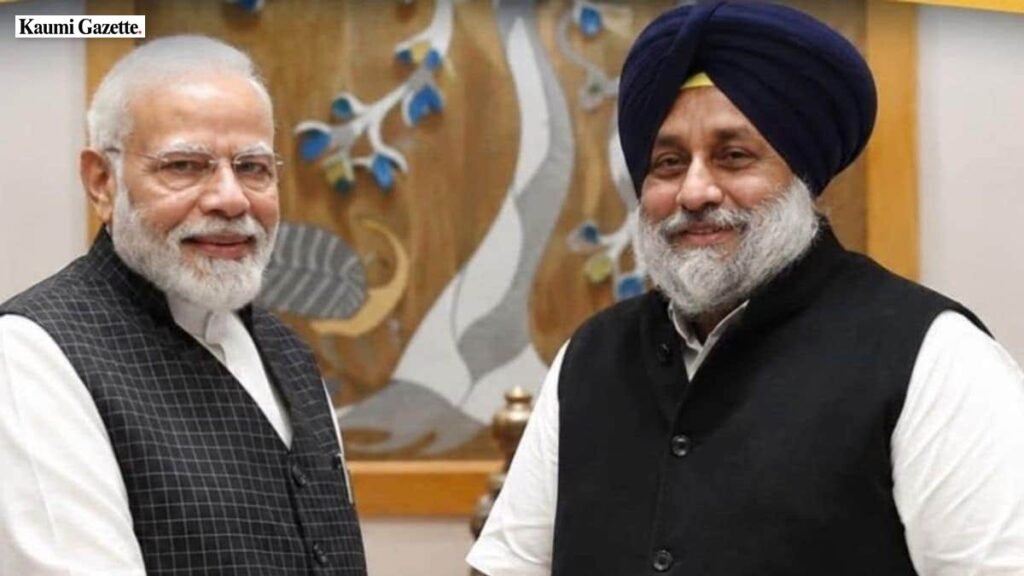
CHANDIGARH — Ahead of the upcoming assembly elections in Punjab, political speculation has intensified over a potential re-alliance between the Shiromani Akali Dal (SAD) and the Bharatiya Janata Party (BJP), a partnership that analysts and party insiders view as vital for the survival of the regional outfit.
While reports citing Akali leadership indicate that party president Sukhbir Singh Badal will take the final decision regarding any coalition, senior SAD leaders have repeatedly voiced support for the partnership over the past three months. Momentum for the reunion gathered pace following a meeting between Sukhbir Singh Badal and Prime Minister Narendra Modi on August 7. Shortly after, the SAD reversed its earlier opposition to support the women’s reservation bill and the Centre’s proposed 50 percent increase in assembly seats.
Public remarks by prominent Akali leaders have further fueled the discussions. Harsimrat Kaur Badal remarked at an event that she wished for such an alliance to resume development work funded from New Delhi, while her brother and party leader Bikram Singh Majithia stated that the public desires a reunion between the two parties. Another Akali leader described the potential tie-up as the voice of the public.
Electoral data from recent polls underscores the arithmetic driving the push for an alliance. During the 2019 Lok Sabha elections, the SAD-BJP alliance secured a combined vote share of 37.08 percent and won four seats. Following their split, the BJP’s vote share rose from 9.63 percent in 2019 to 18.56 percent in 2024, whereas the SAD’s vote share dropped sharply from 27.45 percent to 13.42 percent.
Despite contesting separately in 2024, their combined vote share of 31.98 percent remained higher than that of the Congress at 26.30 percent and the ruling Aam Aadmi Party (AAP) at 26.02 percent. Yet, divided, the BJP failed to win a single Lok Sabha seat, while the SAD managed only one. Assembly figures reflect a similar decline: in the 2017 elections under the alliance, the SAD won 15 seats and the BJP three, but in the 2022 elections following their separation, the SAD was reduced to three seats and the BJP to two.
The SAD’s electoral decline has left the party with just one MLA and one Lok Sabha MP. Of the three legislators elected in 2022, one subsequently joined the AAP and another moved to Waris Punjab De. Furthermore, during the 2024 Lok Sabha elections, SAD candidates lost their security deposits in 10 of the 13 constituencies they contested.
For the BJP, an alliance offers a complementary demographic reach. The BJP maintains a strong base among urban voters in Punjab, whereas the SAD traditionally holds deep influence in rural, Sikh, and agrarian regions. Despite doubling its vote share to 18.56 percent in 2024, the BJP was shut out of the Lok Sabha seats entirely, highlighting the limits of its standalone reach across rural constituencies.
However, reviving the partnership presents significant political challenges for the Akali Dal. The AAP and Congress have aggressively campaigned on allegations that the SAD is desperate to reunite with the BJP. Chief Minister Bhagwant Mann frequently invokes the nationwide farmers’ agitation against the Centre’s former agricultural laws—during which over 750 farmers died—alongside historical issues of sacrilege and drug trafficking to target the Akali leadership. Consequently, the SAD faces the uphill task of convincing its traditional rural base how a partnership with the BJP is tenable after previously severing ties over the farm laws.
Related stories
 HeadlinesCongress launches nationwide campaign demanding removal of Chief Election Commissioner and electoral reforms
 HeadlinesKarnataka voter list shrinks by nearly eighteen percent following revision exercise by Election Commission
 HeadlinesSaudi coalition intercepts missiles over Riyadh, damaging Aramco building
More from Explainers
 HeadlinesSonia Gandhi describes upcoming memoir as personal narrative rather than political book
 HeadlinesNew Zealand Election Ends in Tight Contest Pointing Toward Coalition Negotiations
 HeadlinesIsraeli President Tasks Opposition Leader Gadi Eisenkot With Forming New Government
 HeadlinesDiscrepancy emerges between electoral rolls in Rajasthan as millions of voters missing from national lists
 ExplainerUttar Pradesh government increases Dearness Allowance by five percent for state employees
 HeadlinesCockroach Janta Party Founder Calls for Democratic Removal of Government at Kochi Protest