
Election Commission revision leaves families divided across polling booths in Karnataka
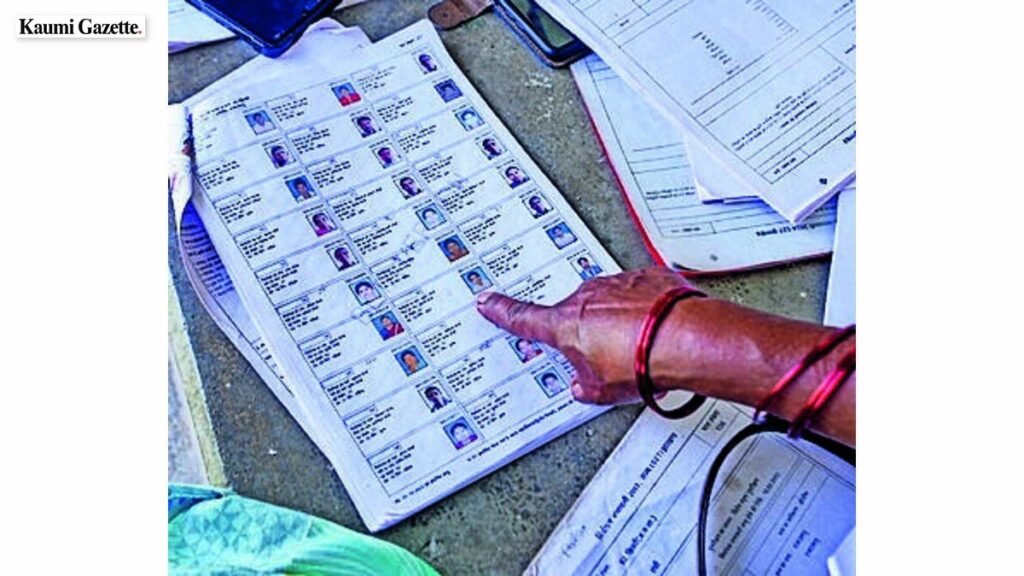
BENGALURU — The Election Commission’s special intensive revision (SIR) and rationalisation of polling stations have left several families divided across different booths in Bengaluru and other parts of Karnataka, even as authorities maintain that household units were meant to be kept together.
The revision exercise aimed to cap booths at a maximum of 1,200 voters and ensure polling stations are located within two kilometres of voters’ homes. According to an official from the office of the chief electoral officer, roughly 1,875 new polling stations were added during the process. The reallocation decisions were drawn from a matrix prepared by booth-level officers (BLOs), supervisors, and electoral registration officers (EROs).
While officials stated that family members were identified as single units for allocation, residents reported that multiple BLOs visited individual homes during enumeration because different members were mapped to separate polling stations.
The exercise has created practical hurdles for voters, who are struggling to locate names following changes to polling station part numbers and serial numbers. Volunteers assisting the public noted that individuals relying on pre-SIR details face difficulties tracing their entries in the updated rolls.
Residents have also questioned the implementation of the rationalisation drive. Raj Kumar, a resident of RT Nagar, said his 22-year-old son was assigned a booth in the neighbouring CV Raman Nagar constituency, while the rest of the family remained listed in Shanti Nagar. He added that the anomaly persisted from previous rolls despite living at the same address for 50 years, leaving the family uncertain about whether to use Form 8, which requires specifying old and new addresses.
Voters across regions further reported persistent errors regarding names, ages, and addresses. A voter in Dakshina Kannada stated their age was increased by three years, while a Bengaluru resident said a requested correction through a BLO was ignored, listing them as 56 instead of 54.
In Yelahanka, entries featured incomplete addresses where house numbers were replaced with dots, hyphens, or local landmarks such as temples. BLO Nagarathnamma explained that entries matched the information provided during field visits, noting that neighbours assisted in identifying voters using photographs where details were vague.
Yelahanka ERO Maruthi acknowledged the discrepancies, attributing some to potential data entry errors, and assured that a review would be conducted. He added that the software functioned without issues and that Yelahanka recorded the highest progress with the lowest deletions.
Related stories
 OpinionOpposition leaders accuse Election Commission and ruling party of electoral roll irregularities
 OpinionRecent police appeals at mosques reignite debate over minority political engagement in India
 ExplainerHow black holes become cosmic monsters: Scientists uncover the violent merger chain behind giant space objects |
More from Analysis
 ExplainerWhy the ‘Trump rally’ is hitting a wall of profit-takingExplainerWhy India’s defence sector boost drone output for next-gen combatExplainerHow decentralising therapy can help bridge India’s treatment gapExplainerUnderstanding inequality in India’s growth story
 NationalIn bid to decentralise school governance, Centre mandates, empowers local committees
 ExplainerWhy industrial heat pumps are a ‘clean heat’ opportunity for India