
Garment workers stage widespread protests across Bangladesh demanding higher minimum wages
DHAKA —
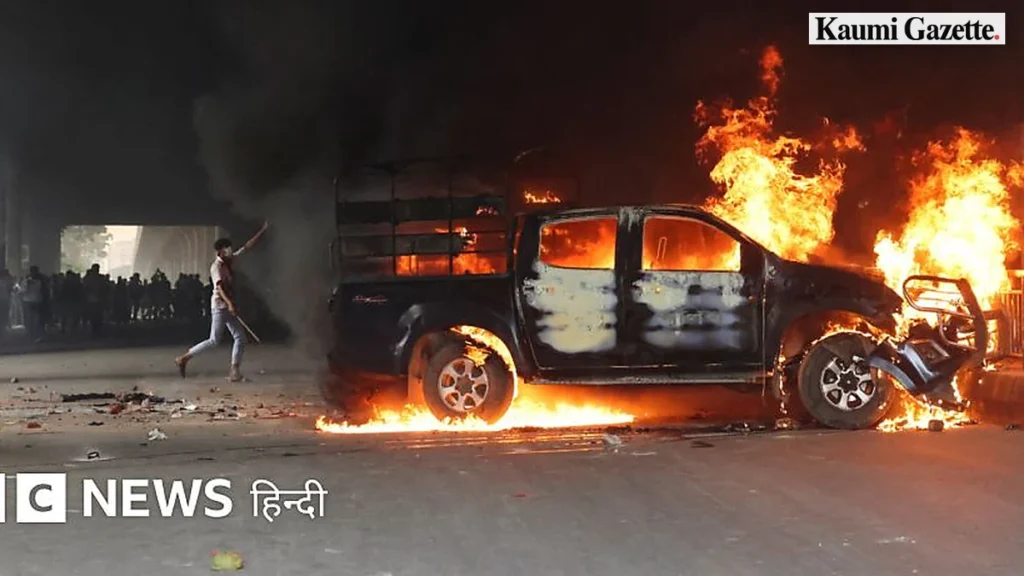
Nearly one million garment workers staged widespread protests across Bangladesh on Sunday, bringing production to a halt at 529 factories and prompting an emergency government response.
The demonstrators are demanding that their minimum monthly wage be increased to 30,000 taka (approximately 21,000 rupees), up from the current wage of 12,500 taka (approximately 8,800 rupees). According to workers, soaring costs for food, housing, transport, and healthcare have severely eroded their purchasing power. Several workers told broadcasters that they intend to continue their protests until an official announcement regarding a higher minimum wage is made.
The nationwide protests led to factory shutdowns, clashes with police, and incidents of vandalism across key industrial hubs, including Dhaka, Savar, Ashulia, Mirpur, Gazipur, and Kaliakair. In response to the unrest, Prime Minister Tarique Rahman convened an emergency meeting to address the situation.
Labour and Employment Minister Ariful Haque Chowdhury announced the formation of a six-member wage board on Sunday to review the demands and urged workers to halt their demonstrations. The newly formed wage board is tasked with determining the minimum wage after considering all viewpoints and surrounding circumstances.
While workers point to inflation and financial hardship, government officials and industry leaders have alleged that political motivations are driving the escalation.
Home Minister Salahuddin Ahmed claimed that masked individuals have infiltrated the protests to advance their own interests, alleging that cross-border incitement is being used to target the country’s export trade and garment sector. Labour Minister Chowdhury similarly asserted that individuals linked to Awami fascism orchestrated these activities with an eye on December. Law enforcement agencies reported that leaders and activists from the banned Awami League and associated organizations were involved in the violent demonstrations in Dhaka and Gazipur.
Mohammad Hatem, president of the Bangladesh Knitwear Manufacturers and Exporters Association (BKMEA), expressed skepticism over the core motivations of the rallies, stating that the unrest stems from something beyond wage concerns and may involve a conspiracy against the government. “If actual workers were involved in this, it would have ended on the first day itself,” Hatem said.
The unrest unfolds against a backdrop of recent political volatility in Bangladesh, marked by the 2024 student-led protests that unseated former Prime Minister Sheikh Hasina, the subsequent establishment of an interim administration, and the transition of power following general elections. Additional tensions emerged following political violence in December 2025 surrounding the killing of student leader Sharif Usman Hadi, alongside ongoing discussions regarding the potential return of former Prime Minister Sheikh Hasina this December.
Related stories
More from World
 WorldFrench Authorities Open Investigation After Petrol Bomb Thrown at Police Amid European Unrest
 WorldTrump Campaigns in Iowa and Kansas to Defend Congressional Majorities Ahead of Midterms
 WorldArab Political Factions Emerge as Potential Kingmakers After Inconclusive Israeli Elections
 WorldReports Indicate Chinese AI Firms Utilized OpenAI Outputs to Train Systems
 WorldAfrica CDC Warns of Global Spread as Ebola Outbreak Exceeds 10,000 Cases
 WorldFederal Reserve Expected to Leave Interest Rates Unchanged Ahead of Midterms