
Parliament special sitting revives debate over women quota and delimitation
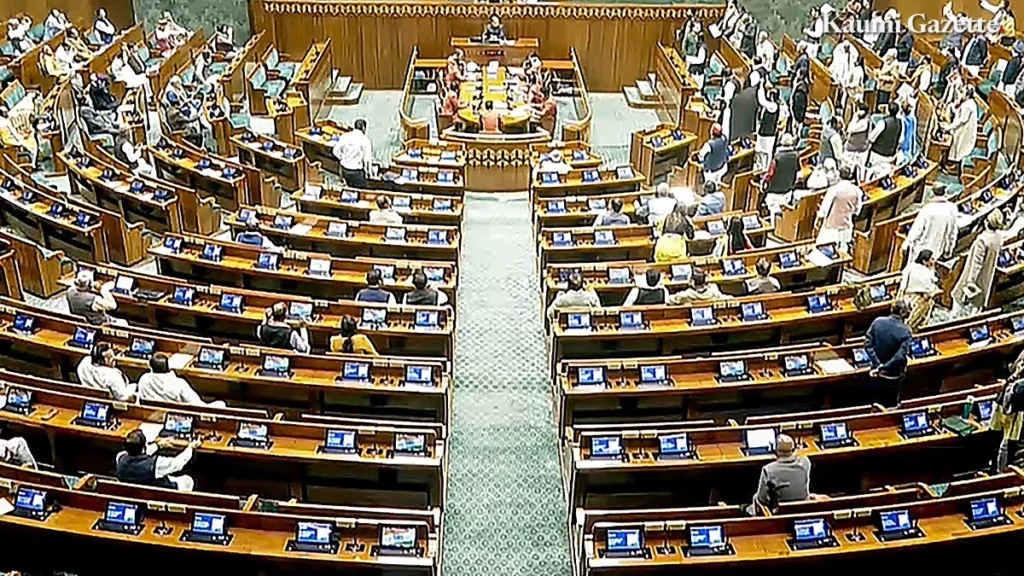
NEW DELHI: The Centre’s proposal to convene a special sitting of Parliament has revived intense political debate over legislative measures to expand the size of the Lok Sabha and fast-track a 33% reservation for women.
While the government has not officially announced the agenda for the proposed special sitting, political speculation has intensified because authorities did not prorogue the Monsoon Session, which was adjourned sine die on August 13. Observers and political circles expect the sitting could be utilised to push through the stalled 131st Constitution Amendment Bill alongside a linked delimitation measure.
The legislative push faced a major setback in April, when the 131st Constitution Amendment Bill failed to secure the mandatory two-thirds majority in the Lok Sabha. It marked the first time a constitutional amendment brought by the government had been defeated since the National Democratic Alliance (NDA) came into power in 2014. Following that defeat, the government withdrew two connected bills: one that mandated delimitation based on the latest available census, effectively the 2011 count, and another that implemented the corresponding changes in Union Territories.
Under constitutional provisions, amendment bills can be introduced in either House of Parliament. While initial introduction motions require a simple majority, passing effective clauses and final consideration motions demands a majority of the total House membership alongside at least two-thirds of the members present and voting.
The defeated 131st Constitution Amendment Bill sought to raise the Lok Sabha seat ceiling to 850 and enforce the 33% quota for women in time for the 2029 general elections. The measure fell short after encountering a united opposition. The defeat occurred despite a dramatic last-minute offer from Union Home Minister Amit Shah to incorporate a 50% proportional rise for all states into the legislation.
While ruling coalition members took to the streets in protest against the bill’s defeat, opposition parties maintained that while they supported women’s reservation, they strongly opposed the proposed delimitation framework, questioning both the government’s timing and its underlying intent.
The broader issue of reserving a third of legislative seats for women has a long parliamentary history, having been debated since the Constituent Assembly initially rejected the concept. Throughout the 1990s and 2000s, repeated attempts to pass similar legislation were thwarted by regional parties. A major milestone occurred in 2010 when the measure cleared the Rajya Sabha before stalling in the Lok Sabha. Eventually, the Nari Shakti Vandan Adhiniyam was passed by Parliament in 2023, mandating that the 33% women’s reservation be implemented following a fresh census and delimitation exercise. The 2023 legislation remains legally valid and came into force in April of this year.
During the subsequent budget session, however, the government introduced three bills designed to delink the women’s quota from future population censuses and tie it directly to a delimitation exercise based on the 2011 census. This legislative framework involved raising the total seat cap in the Lok Sabha, with exact seat allocations, reserved constituencies, and boundaries to be mapped out by a delimitation commission using the 2011 population data.
The legislative proposals triggered a sharp North-South political divide. Critics and southern regional leaders denounced the exercise as flawed, unconstitutional, and anti-federal. A central contention is that northern states stand to gain significantly more parliamentary seats in proportion to their population size, whereas southern states (which contribute roughly 30% to 31% of the national GDP) could see their relative political weight diminish due to population-based metrics. Southern leaders have consistently argued that population size alone should not serve as the sole criterion for such legislative revisions.
In response, the government countered that under a uniform 50% increase across regions, the collective share of Lok Sabha seats held by southern states would actually rise marginally from 23.76% to 23.87%. However, critics have pointed out that the text of the bill itself provided no statutory guarantee ensuring that specific formula.
Related stories

More from India
 NationalPalestinian Envoy Abdullah Abu Shawesh Meets Sri Sri Ravi Shankar at Art of Living Centre
 NationalNorthern Railway Organizes Capacity Building Programe for Traction Power Controllers (TPCs)
 HeadlinesCongress plans nationwide protests on Constitution Day over alleged electoral roll irregularities
 HeadlinesGrameen Bank branches face coordinated attacks amid political tensions in Bangladesh
 HeadlinesSupreme Court directs priority hearings for millions of appeals regarding deleted voter names in West Bengal
 HeadlinesNepali Prime Minister Balen Shah Prioritizes India for First Foreign Visit Amid Economic and Diplomatic Realities