
Maharashtra challenges FSSAI in Bombay High Court over state regulatory authority

MUMBAI — The Maharashtra government has moved the Bombay High Court against the Food Safety and Standards Authority of India (FSSAI), alleging that the national food regulator has encroached on state powers and established an unauthorized parallel enforcement mechanism.
The petition, filed through Maharashtra Food Safety Commissioner Tukaram Mundhe, brings to the fore a broader jurisdictional conflict between the Centre and the states regarding food safety regulation under the Food Safety and Standards Act, 2006. At the heart of the legal challenge are administrative orders issued by the FSSAI that alter licensing thresholds and restrict state enforcement officers from inspecting major food businesses.
According to an FSSAI order dated March 13, 2026, the turnover thresholds governing food business licences were substantially revised. Under the updated framework, food businesses with an annual turnover of up to Rs 1.5 crore require registration, those with a turnover up to Rs 50 crore require a state licence, and enterprises exceeding Rs 50 crore require a Central licence. This represents a shift from earlier norms, where companies with an annual turnover of up to Rs 12 lakh required registration, businesses with turnover between Rs 12 lakh and Rs 20 crore needed a state licence, and entities with more than Rs 20 crore required a Central licence.
Further compounding the friction between state and central authorities, an earlier FSSAI order dated May 12, 2023, mandated that all Centrally licensed food businesses must be inspected exclusively by Central Food Safety Officers (FSOs).
The Maharashtra government’s petition contends that these directives create a parallel regulatory structure without statutory backing. Critics of the central mechanism point out that Section 31(3) of the Food Safety and Standards Act, 2006, stipulates that any person wishing to commence or carry on a food business must apply for a licence to the designated officer, raising questions over the legal basis for appointing dedicated Central FSOs. Observers have noted that while the Maharashtra Food and Drug Administration currently performs strongly under Commissioner Mundhe—who is noted for strict enforcement actions—such administrative vigor may fluctuate depending on leadership changes.
Defending the central mechanism, a senior official from the Central authority argued that establishing a central inspection framework ensures that larger businesses remain under consistent oversight, addressing potential variations in enforcement standards across different states.
The matter will be processed and heard by the Bombay High Court to determine the legal boundaries of state and central authority under the 2006 statute.
Related stories



More from India
 NationalOpposition Alliance Stages Delhi Protest to Demand Removal of Chief Election Commissioner
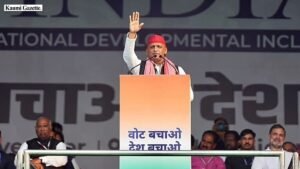 NationalAkhilesh Yadav and opposition leaders rally in New Delhi to protest alleged electoral irregularities
 NationalLal Hit Janta Party holds counter demonstration in New Delhi supporting Prime Minister Modi
 NationalNEW DELHI: Tens of thousands of demonstrators gathered at Ramlila Maidan in Delhi on Sunday for a
 NationalElection Commission Suspends Two Former Magistrates Over Pilibhit Voter List Irregularities
 NationalNEW DELHI: The Ministry of Labour and Employment has notified the constitution of two distinct bodies aimed