
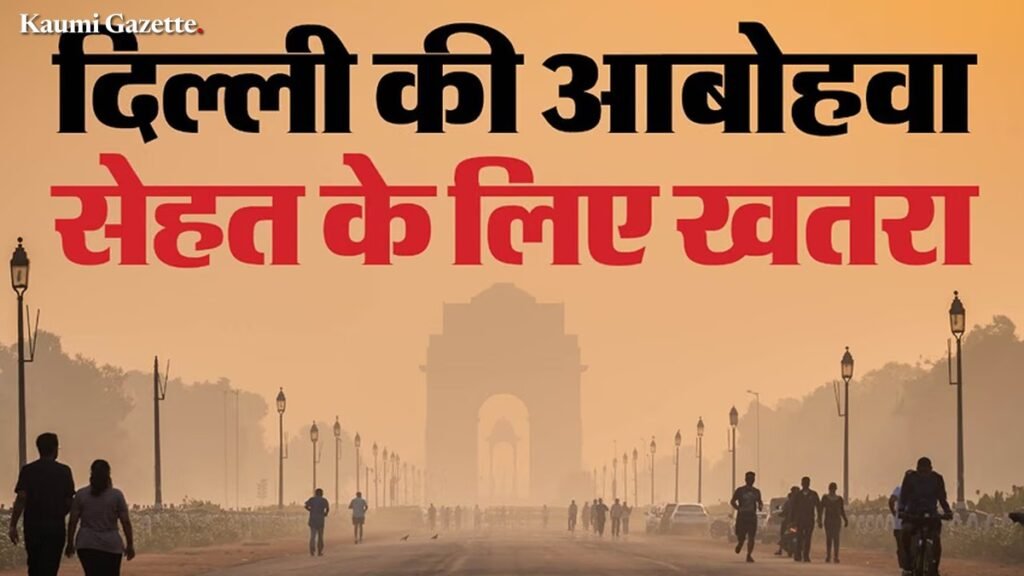
Delhi air quality plunges into severe category as pollution levels exceed thresholds
NEW DELHI —
Delhi-NCR’s air quality has worsened into the ‘severe’ category, with pollution levels exceeding World Health Organization limits by nearly 20 times.
According to the Central Pollution Control Board (CPCB), the overall Air Quality Index crossed the 400 mark, while certain areas in the national capital recorded readings near 500. Under these conditions, healthy individuals can experience breathing difficulties, while the risks are significantly magnified for those suffering from asthma, cardiovascular conditions, and chronic respiratory ailments.
At the center of this public health concern is particulate matter 2.5, commonly known as PM2.5. These microscopic airborne particles have a diameter of 2.5 micrometers or less, making them roughly 30 times smaller than the width of a human hair. Comprising dust, smoke, soot, vehicular emissions, industrial discharge, and crop residue burning, their diminutive size allows them to bypass natural filtration barriers in the nose and throat.
While larger dust particles are generally trapped in the upper respiratory tract, PM2.5 particles penetrate deep into the interior regions of the lungs. Some finer particles even cross the lung’s protective membrane to enter the bloodstream, subsequently affecting other vital organs. Prolonged exposure heightens the risk of respiratory diseases, heart disease, stroke, and lung cancer in otherwise healthy individuals, establishing PM2.5 as one of the most concerning components of air pollution.
India measures air quality using the CPCB’s National Air Quality Index, designed to translate complex pollution data into accessible numerical values and color codes across six distinct categories. The index calculation accounts for eight specific pollutants: PM2.5, PM10, nitrogen dioxide, sulfur dioxide, carbon monoxide, ozone, ammonia, and lead. CPCB standards classify an AQI between 0 and 50 as good, causing minimal health impacts. However, international public health bodies maintain that no level of air pollution can be considered entirely risk-free.
A substantial gap exists between domestic air quality benchmarks and international guidelines. The National Ambient Air Quality Standards set India’s annual average limit for PM2.5 at 40 micrograms per cubic meter, with a 24-hour average limit of 60 micrograms per cubic meter. In contrast, the WHO recommends a much stricter annual average limit of 5 micrograms per cubic meter and a 24-hour limit of 15 micrograms per cubic meter.
Medical research indicates that the physiological damage caused by polluted air extends far beyond the respiratory system. In the lungs, PM2.5 and PM10 particles induce inflammation and irritation within the airways, aggravating conditions such as asthma and bronchitis. Over time, persistent exposure reduces overall lung capacity, restricting the body’s ability to oxygenate properly and elevating the incidence of chronic obstructive pulmonary disease and lung cancer.
As particulate matter enters the bloodstream, it alters vascular function and causes systemic inflammation, raising blood pressure, increasing the likelihood of blood clots, and elevating the risk of heart attacks and strokes. External barriers such as the skin and eyes are also compromised; fine dust, smoke, and ozone trigger oxidative stress that damages collagen, leading to premature aging, eczema, and severe eye irritation. Furthermore, airborne pollutants can disrupt immune function and pose distinct health risks to pregnant women and developing fetuses.
The escalation in Delhi’s pollution levels stems from a convergence of local emissions and meteorological factors. Vehicular exhaust, industrial output, construction dust, and crop residue burning combine with winter weather patterns—characterized by low temperatures, sluggish winds, and minimal atmospheric dispersion—to trap pollutants near the ground.
Health authorities recommend several precautionary measures to mitigate exposure during severe pollution episodes. Residents are advised to wear well-fitting masks outdoors, avoid outdoor exercise, keep doors and windows closed during peak pollution hours, and maintain indoor ventilation while cooking. Vulnerable populations, particularly children, the elderly, and pregnant women, are urged to limit outdoor exposure, while individuals experiencing persistent coughing, chest pain, or breathing difficulties are advised to seek medical attention.
Related stories
 HeadlinesSamajwadi Party claims identification of duplicate voters and plans submission to Election Commission
 HeadlinesCongress launches digital platform to monitor electoral rolls and verify voter data
 HeadlinesActivist Coalition Announces Nationwide Campaign to Demand Scrapping of Electoral Revision Process
More from India
 HeadlinesElection Commission releases draft voter rolls showing expansion across nine states and territories
 HeadlinesDraft Electoral Rolls Record Electors Increase Across Nine Regions Following Election Commission Revision
 HeadlinesUnion government plans special parliamentary session to advance women reservation and Lok Sabha expansion bill
 NationalIndia Retail Inflation Exceeds Target Ceiling at 6.09% in October
 HeadlinesNetanyahu Calls for Unity Government Amid Knesset Tensions and Opposition Walkouts
 HeadlinesActivists Urge Election Commission to Expand Voter Relief Measures Nationwide