
Netanyahu Calls for Unity Government Amid Knesset Tensions and Opposition Walkouts
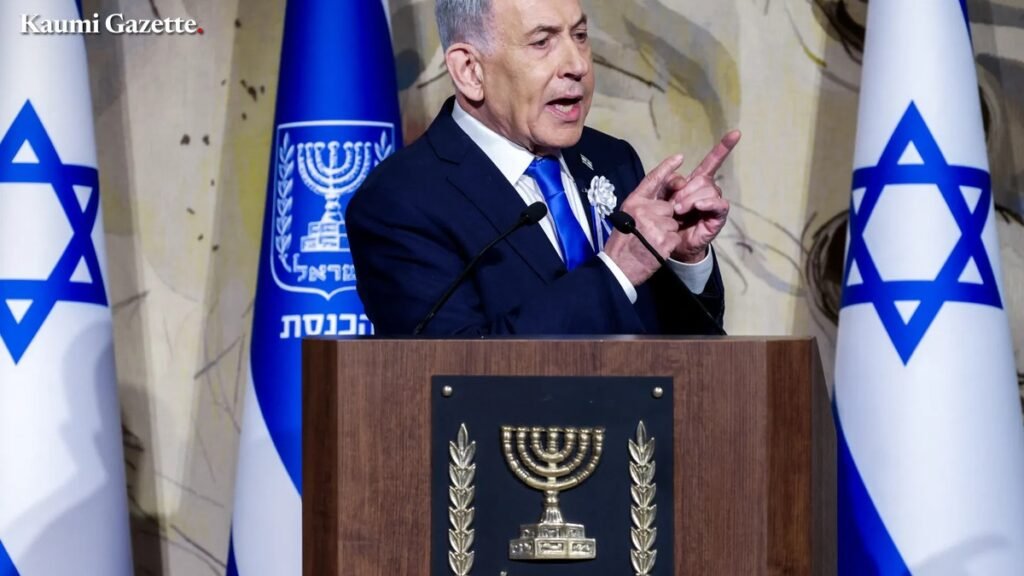
JERUSALEM — Prime Minister Benjamin Netanyahu called for a national unity government during a contentious Knesset opening session on Tuesday, as opposition lawmakers responded with heckles, catcalls, and walkouts.
The swearing-in of Israel’s new parliament exposed deep fractures across the political spectrum. While the opposition holds a parliamentary majority, it has yet to assemble a governing coalition. Gadi Eisenkot has been given the first opportunity to form a new government, and has canceled previously scheduled coalition talks with Netanyahu while declaring him unfit for office.
During his address, Netanyahu urged political factions to set aside differences to confront major regional challenges. “We must do one thing – set aside every other consideration and form a national unity government. Only such a government will be able to meet challenges of this magnitude. It is impossible to handle them with a narrow government,” Netanyahu told the parliament.
The prime minister also warned against narrow administrations, stating that such arrangements could involve parties that act as “terror supporters, haters of Israel, or would be dependent on them.” According to Al Jazeera, Netanyahu pointed to the ongoing threat posed by Iran and accused democratically elected lawmakers representing Palestinian citizens of Israel of seeking the country’s destruction. In protest against the remarks, Palestinian members of the Knesset walked out of the chamber.
The parliamentary session was further marked by sharp verbal exchanges. Former Prime Minister Naftali Bennett traded barbs from the floor with Netanyahu’s wife, Sara, and hard-right ally Itamar Ben-Gvir.
Israeli politics has historically been characterised by coalitions where individual personalities frequently overshadow party platforms. Analysts point out that campaigns have grown increasingly personalised over recent decades. Roi Zur stated that Netanyahu Americanised the local party system and transformed Likud into a populist party. Dahlia Schneidlin noted the shift toward personality-driven politics despite elections operating on party slate votes, while Yossi Mekelberg observed that centralised party structures can allow leaders to act without institutional constraint.
Netanyahu faces an uncertain political future outside of office, compounded by an ongoing corruption trial and potential inquiries into security failings surrounding the October 7, 2023, Hamas-led attack. Eisenkot will now proceed with efforts to form a viable governing coalition.
Related stories


More from India
 HeadlinesBJP Focuses on Grassroots Network and Governance in Uttar Pradesh Preparations
 NationalSecurity threats forced abrupt withdrawal of Rahul and Priyanka Gandhi from boarding schools in 1984, Sonia Gandhi reveals
 HeadlinesYogi Adityanath alleges large-scale omission of Hindu voters from rolls in Uttar Pradesh
 HeadlinesUnion Cabinet approves Noida metro extension and Yuge Yugeen Bharat Museum funding
 NationalGauhati High Court Rules PAN and Voter Cards Do Not Prove Citizenship
 HeadlinesUttar Pradesh Government Waives Recovery Demand for Promoted Police Personnel