
ANTALYA: World leaders and delegates are gathering in Antalya, Turkiye, for the United Nations COP31 climate summit,
ANTALYA — World leaders and delegates are gathering in Antalya, Turkiye, for the United Nations COP31 climate summit, scheduled to run from November 9 to 20, amid fresh figures showing global greenhouse gas emissions reached 54.1 billion tonnes in 2025.
According to data released by the European Commission’s Joint Research Centre (JRC) and the International Energy Agency (IEA), the 2025 total marked a 0.7 percent increase from the previous year and a 68.5 percent rise compared to 1990 levels. Carbon dioxide accounted for 73.8 percent of global greenhouse gas emissions in 2025, while methane made up 17.6 percent, nitrous oxide 5.3 percent, and fluorinated gases 3.3 percent.
The summit opens against a backdrop of severe global climate metrics and extreme weather events. The World Meteorological Organization (WMO) reported that the heat stored in the world’s oceans reached its highest level on record in 2025, with the rate of ocean warming accelerating sharply over the past two decades. Furthermore, the WMO stated that extreme weather has killed tens of thousands of people and forced millions from their homes in 2026. Among specific disasters, the UN reported that an August 26 glacier collapse and subsequent flash flood in the Himalayas killed more than 1,500 people in Nepal along its border with China, with approximately 5,600 remaining missing. Additional climate impacts in 2026 included European heatwaves, droughts, and wildfires between May and August that caused more than 30,000 excess deaths, alongside 220,000 evacuations in France alone.
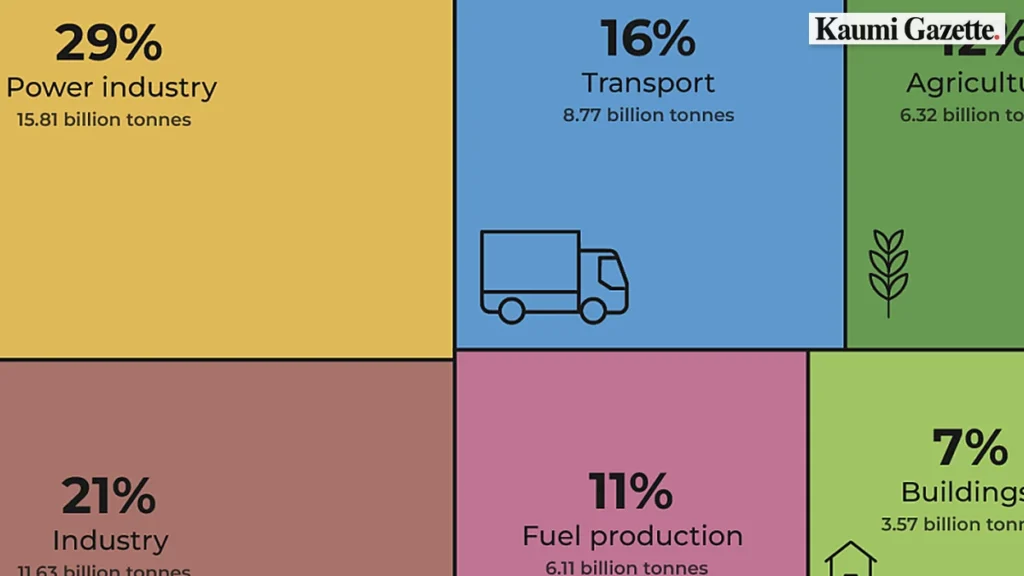
Sectoral breakdowns indicate that the power industry remains the largest single source of emissions, producing nearly 30 percent of global emissions in 2025—roughly quadrupling since 1970. Industry followed as the second-largest source at 21 percent, transport at 16 percent, agriculture at 12 percent, coal, oil and gas extraction at 11 percent, buildings at 6.6 percent, and waste at 3.6 percent. International shipping and aviation accounted for 2.6 percent.
Geographically, major economies continued to drive the bulk of annual volumes in 2025. China emitted almost 16 billion tonnes, representing 29.5 percent of the global total; the United States emitted 6.02 billion tonnes, or 11.1 percent; and India produced 4.51 billion tonnes, or 8.3 percent. The 27 European Union countries accounted for 5.8 percent, Russia 4.8 percent, Indonesia 2.5 percent, Brazil 2.4 percent, and Iran 2.1 percent.
National emissions profiles vary widely by sector. In China, the power sector generates 42 percent of emissions, industry 31 percent, and fuel production 9.5 percent. In the United States, transport leads at 29 percent, followed by the power sector at 26 percent and industry at 14 percent. In India, the power sector produces 35 percent of emissions, industry 24 percent, and agriculture 19 percent.
From a historical perspective, cumulative emissions trace back to the Industrial Revolution of the 18th and 19th centuries, which drove up emissions first in the West, particularly in the UK and US. Global emissions rose sharply after World War II and have more than doubled since 1970, with China ultimately overtaking the US as the world’s largest annual emitter in the mid-2000s following an economic boom. According to the Global Carbon Budget, the United States has produced 23.5 percent of all CO2 emissions since the mid-18th century, compared with 15.4 percent from China.
Policy adjustments are underway among major contributors. In September 2025, Chinese President Xi Jinping pledged to cut the country’s greenhouse gas emissions by 7 to 10 percent from their peak by 2035.
Related stories



More from World
 HeadlinesSaudi coalition intercepts missiles over Riyadh, damaging Aramco building
 HeadlinesIsraeli President Tasks Opposition Leader Gadi Eisenkot With Forming New Government
 WorldUnited States Offers Twenty Million Dollar Reward For Information On Iran Nuclear Programme
 WorldChina Manned Space Agency: Pakistani Astronaut Set for Tiangong Station Mission
 WorldZelensky reports overnight aerial assault on Kyiv as officials prepare for talks in Abu Dhabi
 HeadlinesDozens killed in missile strike on Taiz market amid escalating Yemen conflict