
Election Commission assures Supreme Court that voters restoring names using Form 6 face no prosecution
NEW DELHI:
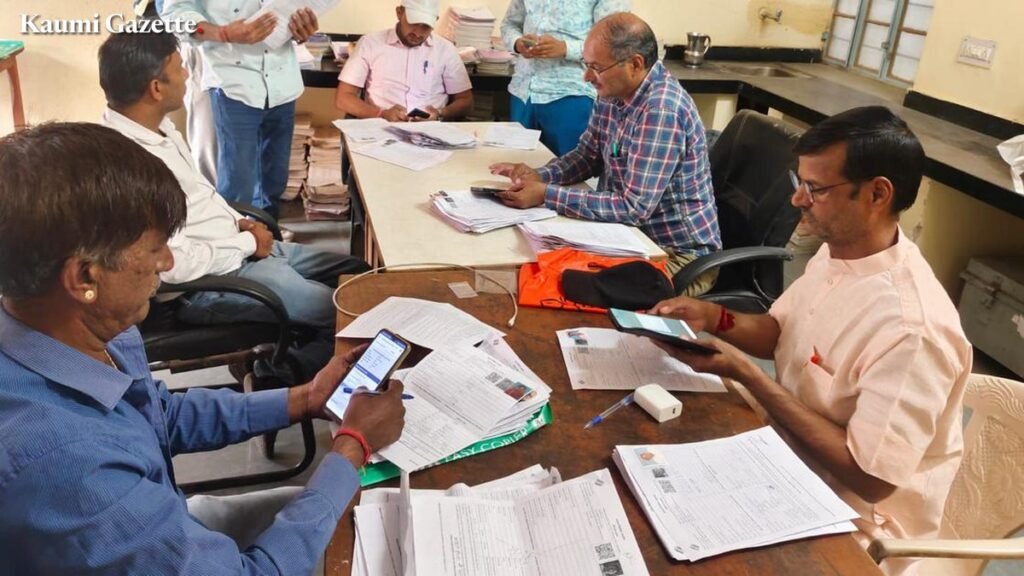
The Election Commission has informed the Supreme Court that voters who submit Form 6 to restore their names to electoral rolls after exclusion during the special intensive revision will not face prosecution for making a false declaration.
The poll panel’s written assurance was submitted in a supplementary affidavit filed in the Supreme Court on Saturday. The filing responded to a petition concerning the functioning of Chief Election Commissioner Gyanesh Kumar, which alleged that decisions regarding the voter roll revision were made without the concurrence of the other two election commissioners.
Form 6 is structurally designated for first-time voter registration, creating initial hesitation among individuals whose names were omitted during the special intensive revision (SIR) of electoral rolls. Many voters worried that using the form despite prior enrolment would constitute a false declaration under the Representation of the People Act, 1950, carrying potential liability for prosecution.
Addressing this concern, the Election Commission issued a letter on November 3 to chief electoral officers across all states and Union Territories. The letter clarified that submitting Form 6 to seek reinstatement after deletion from draft rolls does not constitute a false declaration, provided the applicant is not concurrently enrolled in another constituency and the declaration complies with the law. The commission noted that individuals whose names are absent from draft rolls must seek inclusion afresh, regardless of prior registration.
The poll panel stated that its November 3 directive aligned with an October 14 ruling by the Delhi High Court. The High Court had held that apprehensions regarding prosecution under Form 6 were misplaced since the remedial directive originated from the Election Commission itself. On October 1, the poll panel had directed state units where the revision had concluded to identify and restore eligible voters wrongly excluded, using Form 6.
The procedure previously drew criticism. Former Chief Election Commissioner SY Quraishi had publicly stated on social media that Form 6 was restricted to new voters and that requiring deleted voters to use it amounted to forcing a criminal offence carrying a one-year prison term.
On October 28, a Supreme Court bench headed by Chief Justice Surya Kant questioned why previously enrolled voters deleted for not filling enumeration forms were directed to use Form 6 instead of Form 8, which is meant for address changes, or the original enumeration forms. The bench noted that some voters in Delhi might have missed enumeration in July due to travel or relocation. The poll panel’s counsel stated that authorities would examine the court’s suggestions.
In its Saturday affidavit, the Election Commission added that on November 6 it granted another opportunity for inclusion in final rolls to individuals in Delhi and six states who received enumeration forms but were excluded from draft lists after being marked absent, shifted, dead or duplicate.
The special intensive revision began with its first phase in Bihar in 2025, extended to 12 states and Union Territories in late 2025 and early 2026, and is currently underway across 19 states and Union Territories. While the Supreme Court upheld the legality of the revision in May, it ruled that the exercise does not empower the poll panel to determine Indian citizenship. The revision process has sparked ongoing debate, with critics raising concerns over potential exclusion of genuine voters, subsequent administrative restrictions on ration cards and passport renewals in Bharatiya Janata Party-ruled states, and nationwide protests since October 2 demanding the Chief Election Commissioner’s resignation.
Related stories
More from India
 HeadlinesElection Commission sets January 2027 qualifying date for Karnataka electoral roll revision
 NationalEconomists project Reserve Bank of India rate hikes amid mounting inflation pressures
 ExplainerEl Niño dryness drives India food inflation to twenty-three-month high
 HeadlinesElection Commission releases draft electoral rolls showing voter additions across jurisdictions
 HeadlinesActivists Urge Election Commission to Expand Voter Relief Measures Nationwide
 HeadlinesIndonesian Vice President Gibran Resigns Following Court Rulings and Parliament Pressure