
NEW DELHI: The Supreme Court has verbally remarked that the use of the “logical discrepancy” category during
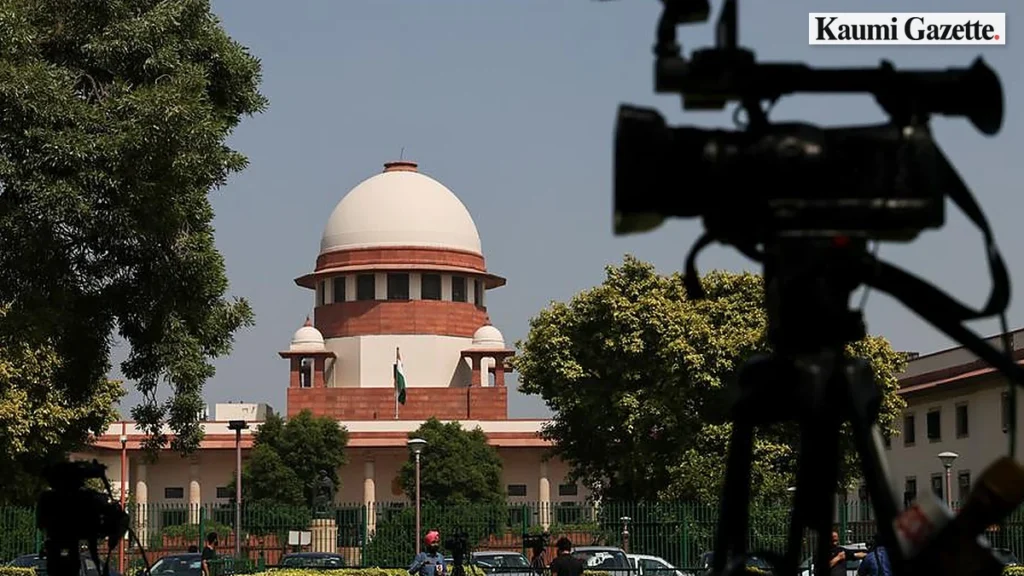
NEW DELHI — The Supreme Court has verbally remarked that the use of the “logical discrepancy” category during the special intensive revision of electoral rolls was permitted in West Bengal merely as an interim arrangement, adding that its ultimate legality remains undecided.
A bench headed by Chief Justice Surya Kant and including Justice Joymalya Bagchi made the observations while hearing petitions that alleged a lack of transparency in the issuance of notices to voters in Delhi during the ongoing revision exercise. According to Bar and Bench, Justice Bagchi stated that a previous judgment concerning Bihar does not serve as a final determination for every question in the current proceedings, noting that the Election Commission had not initially applied the logical discrepancy category in Bihar.
The broader nationwide voter list overhaul stems from a special intensive revision process initiated in Bihar in 2025, which was subsequently expanded to 12 states and Union Territories across late 2025 and the first half of 2026. Under this exercise, the Election Commission has served notices to crores of voters demanding explanations for perceived inconsistencies to protect their voting rights.
Logical discrepancies encompass various data mismatches, such as spelling variations in parents’ names, unusually narrow age gaps between parents and children, or instances where parents are recorded as having more than six children. High-profile individuals, including Delhi Chief Minister Rekha Gupta, former Chief Minister Arvind Kejriwal, and External Affairs Minister S Jaishankar, have received notices under the drive.
Concerns have been raised that the intensive revision could eliminate genuine voters from rolls and potentially influence electoral outcomes. According to Scroll, critics point out that Bharatiya Janata Party-ruled states have cited the revision to deny ration cards to individuals removed from voter rolls, with police in some instances withholding passport renewal clearances.
In Delhi, out of 97.5 lakh voters on the draft electoral roll, notices were issued to 33.1 lakh people—representing roughly one-third of the total electorate. Among those notified, 13.7 lakh individuals could not be linked to electoral rolls from the previous special intensive revision, while 19.3 lakh were flagged for logical discrepancies in their enumeration forms.
However, the Delhi Election Commission reported Tuesday that 31.2 lakh individuals, or over 94 percent of those who received notices, have now been cleared for inclusion in the final electoral roll.
While the Supreme Court previously upheld the legality of the revision in May, it stipulated that the exercise does not empower the Election Commission to adjudicate upon an individual’s Indian citizenship. Chief Justice Kant noted on September 22 that scope exists to clarify what specific information is demanded from voters whose notices cite logical discrepancies.
The final electoral roll is scheduled for publication on December 4.
Related stories
More from India
 NationalNEW DELHI: The Supreme Court has ruled that once the prosecution establishes a public servant holds assets
 NationalNEW DELHI: The Cockroach Janta Party (CJP) has extended its formal support to the INDIA bloc’s upcoming
 NationalKarnataka Congress ministers clash over electoral revision process ahead of national protest
 NationalMUMBAI: Actor Imran Khan has challenged administrative notices seeking the cancellation of his Overseas Citizen of India
 NationalRahul Gandhi urges student participation in capital protest demanding Chief Election Commissioner removal
 NationalINDIA bloc plans mock parliament session to symbolically impeach Chief Election Commissioner Gyanesh Kumar