
The Changing Face of Dalit Politics in North India: Lessons for the Muslim Community
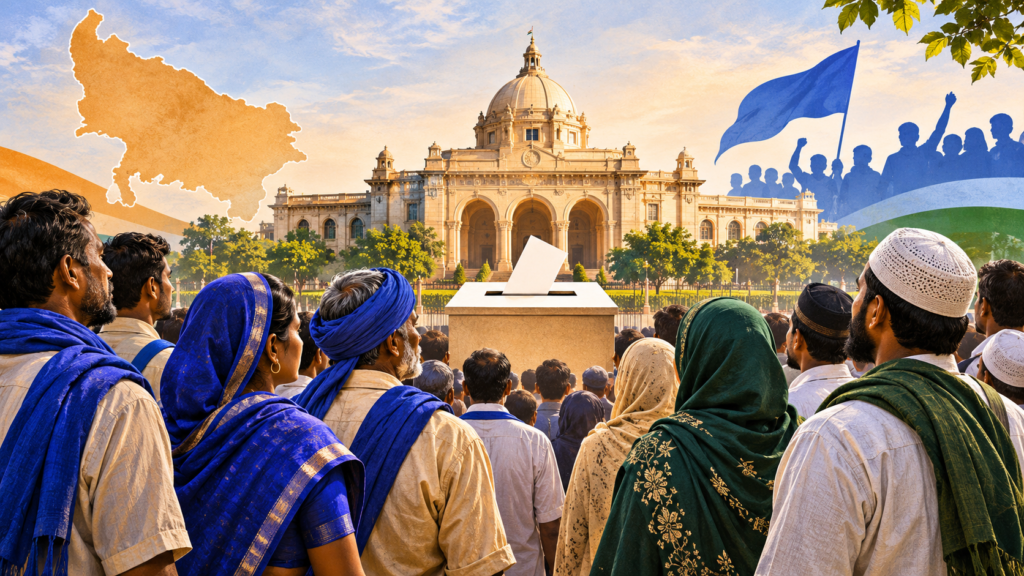
Last month, I happened to attend a massive public rally addressed by Chandrashekhar Azad Ravan in a prominent town in western Uttar Pradesh. A relative of one of my childhood friends had been allotted the Azad Samaj Party ticket from the constituency, and my friend’s earnest request and insistence eventually persuaded me to attend. Although I have no affiliation with any political party, I generally prefer to keep away from the platforms of political organisations.
I arrived a day before the rally and was taken to inspect the venue in the evening. The state president of the Azad Samaj Party was already there, personally supervising every arrangement with meticulous attention to detail. He was examining the audience enclosure, the stage, security arrangements and other logistical preparations. A substantial number of party cadres and members of its social media team were also present.
When I was taken to the stage the following day, I discovered that the entire platform was effectively under the command of party workers. They were managing the seating arrangements, controlling access to the stage and organising the audience. Even the musicians and singers belonged to the party and were engaged in entertaining the gathering before the proceedings commenced. The list of speakers had been personally prepared by the state president, and the entire programme was being conducted with impressive organisational discipline. The audience was overwhelmingly Dalit, although a considerable number of Muslim supporters of the candidate were also present. In short, the provincial and district units of the party exercised complete operational control over the rally, while the entire financial liability rested with the candidate. It was an interesting demonstration of how a political organisation can command the machinery of an event without necessarily bearing its financial burden.
This is the first political landscape. The second dates back to the 2020 Bihar Assembly elections, when Pappu Yadav, the Member of Parliament from Purnia, formed an alliance of several political parties, including the Azad Samaj Party. Chandrashekhar himself participated in the election campaign. He insisted on contesting as many as 100 Assembly seats in Bihar and, despite being a constituent of the alliance, fielded his own candidates against several candidates belonging to its alliance partners. Yet, the electoral response was astonishingly meagre: his candidates failed to secure more than 200 to 300 votes in most constituencies.
The third landscape emerged during the 2022 Uttar Pradesh Assembly elections. After considerable political negotiations, Akhilesh Yadav announced that the Samajwadi Party would allot only two seats to Chandrashekhar’s party. Chandrashekhar himself was to contest one of them. The question of who would receive the second seat, however, triggered such an extraordinary scramble across Uttar Pradesh that a large number of aspirants suddenly emerged. Reports even suggested that the seat was being put up for auction. Within barely 24 hours, Akhilesh Yadav withdrew the offer of both seats. The Azad Samaj Party subsequently fielded candidates across almost the entire state and eventually secured a mere four lakh votes in the entire UP.
The fourth and most consequential landscape unfolded during the 2024 Lok Sabha elections in the Nagina constituency of Uttar Pradesh. Contesting as an independent candidate, Chandrashekhar entered the electoral battle with his full political might and emerged victorious. This triumph catapulted him into considerable national prominence. Before this electoral breakthrough, he had already undertaken substantial grassroots mobilisation for his caste community. This victory is marked with neither the BSP nor the Samajwadi Party had fielded an exceptionally formidable candidate against him. Meanwhile, the Muslim community rallied behind him almost in its entirety, contributing not merely its votes but also its financial resources and organisational support. Hence, his victory consequently became relatively a cakewalk.
This electoral success brought him into prominence as a significant contender for the future leadership of Dalit politics in north India particularly UP.
It is worth recalling that Nagina is the very constituency from which Mayawati first entered the Lok Sabha on a BSP ticket in 1989. Earlier, in the 1985 by-election, she had contested against Meira Kumar, daughter of Babu Jagjivan Ram, securing approximately 61,000 votes and finishing third. The BSP had not even been formally registered at that time, and Nagina was then part of the Bijnor constituency. In a curious historical continuity, the Bijnor region has repeatedly played a consequential role in determining the trajectory of Dalit politics in Uttar Pradesh.
The Electoral Arithmetic of Dalit-Muslim Politics
Taken together, these four landscapes reveal two significant political propositions.
The first is that Dalit politics in North India, particularly in Uttar Pradesh, cannot acquire decisive electoral strength, political predominance and a consequential national presence without forging an effective alliance with other substantial social constituencies, particularly Muslims. Bijnor, for instance, has historically had a Muslim electorate of approximately 44 per cent, compared with barely 21 per cent Scheduled Caste voters. Although several other constituencies in the state have substantial Scheduled Caste populations but lack a comparably influential Muslim electorate.
The political arithmetic is therefore unmistakable. The votes, resources and collective political strength of Muslims cannot be excluded from any serious calculation of electoral success in these constituencies. This is precisely why politicians, particularly when confronted with electoral adversity, invariably turn towards constituencies with a substantial Muslim electorate in search of political reinforcement.
Kanshi Ram understood this equation with extraordinary strategic foresight. Through DS4 and subsequently BAMCEF, he established an extensive intellectual and organisational network, bringing together educated members of the Dalit community, government employees and socially influential individuals. This network transformed dispersed intellectual resources into instruments of collective political mobilisation. A trained and disciplined cadre was developed to travel from village to village, organise small meetings, disseminate political ideas and systematically cultivate political consciousness across North India.
Kanshi Ram, however, was equally conscious that Dalit mobilisation alone could not deliver the political power he aspired to acquire. He therefore began systematically reaching out to Muslim households and leadership circles. Between 1980 and 1990, there was scarcely a prominent Muslim personality in the country whose residence Kanshi Ram did not visit in his effort to secure Muslim participation in his political endeavour.
This sustained outreach explains why his Dalit-Muslim alliance formula found considerable acceptance within the Muslim community. It eventually contributed to the BSP’s electoral breakthrough. The party entered into an alliance with Mulayam Singh Yadav in the 1993 Uttar Pradesh Assembly elections and subsequently formed its own government in 1995 with BJP support. In the 1996 Lok Sabha elections, the BSP secured 11 parliamentary seats for the first time and obtained more than two per cent of the national vote, acquiring national party status—a recognition it continues to retain despite currently having no representative in the Lok Sabha or state assemblies.
However, Kanshi Ram’s political volte-face in 1995 severely undermined Muslim confidence. Despite having given an unequivocal assurance at Jama Masjid of Delhi that the BSP would neither seek support from the BJP nor extend support to it, he subsequently reneged on that commitment. The BSP went on to form governments in Uttar Pradesh with BJP support on several occasions. Muslims interpreted this political manoeuvre as a betrayal of their trust and gradually stop voting for the party.
It was only in 2007 that sections of the Muslim electorate once again supported Mayawati, having concluded that the BSP was perhaps the only political formation capable of defeating the BJP and forming a government in Uttar Pradesh, consequently with this solid support in 2009, BSP could win 21 seats Lok Sabha seats, its highest tally since inception. In the subsequent two elections, political observers have increasingly argued that the BSP facilitated, whether deliberately or otherwise, the transfer of a substantial portion of its electoral support to the BJP.
The Dalit intellectual establishment has now begun to recognise that its social base has become increasingly disillusioned with the BSP. The time has therefore arrived to reconsider its political leadership and consolidate its fragmented social and electoral strength under a new political dispensation. It is equally evident that such a reconstruction cannot succeed without reconnecting with the Muslim community. Given Mayawati’s political record, Muslims are unlikely to repose the same confidence in her leadership again.
The Changing Trajectory of Dalit Politics: North and South
At this juncture, a broader historical perspective becomes necessary. Dalit movements in North and South India have evolved through somewhat different ideological and organisational trajectories, although both have been profoundly influenced by the struggle against caste oppression and the intellectual legacy of Dr B. R. Ambedkar.
In North India, particularly under Kanshi Ram, Dalit mobilisation acquired a distinctly electoral and power-centric orientation. BAMCEF, DS4 and subsequently the BSP represented a carefully conceived progression from intellectual networking to cadre formation, grassroots mobilisation and, ultimately, the direct acquisition of governmental power. The emphasis was on transforming a socially fragmented and politically marginalised population into an organised electoral constituency capable of determining political outcomes and negotiating its share in state power.
The southern trajectory, by contrast, has historically been characterised by a wider spectrum of anti-caste intellectual, social and cultural movements. The struggles associated with Iyothee Thass, Ayyankali, Periyar’s Self-Respect Movement and, subsequently, Dalit organisations such as the Dalit Panthers and the Viduthalai Chiruthaigal Katchi in Tamil Nadu have given particular prominence to social emancipation, cultural assertion, intellectual resistance and the ideological dismantling of caste hierarchies.
The distinction should not be overstated: South India has also produced powerful electoral Dalit formations, while North India has witnessed significant intellectual and social movements. Nevertheless, the contrast is instructive. North India’s most consequential Dalit experiment demonstrated how disciplined cadre-based organisation and strategic electoral alliances could translate social strength into governmental power. Several southern movements, meanwhile, demonstrated how sustained ideological and cultural resistance could challenge entrenched social hierarchies and reshape the broader political discourse.
Chandrashekhar and the Emerging Dalit Political Dispensation
This brings us back to the second proposition emerging from the four political landscapes.
The recent rally clearly indicated that a substantial section of the intellectual establishment, trained cadre and grassroots leadership formerly associated with the BSP has now gravitated towards Chandrashekhar. Former MPs, MLAs and other experienced political functionaries appear to be aligning themselves with his emerging organisation. He is also supported by a disciplined and politically trained cadre whose organisational strength is increasingly becoming visible across different parts of Uttar Pradesh.
The development suggests that Chandrashekhar’s emergence is not merely an individual political phenomenon. It may represent an attempt by the Dalit intellectual and organisational establishment to construct an alternative political vehicle after the erosion of the BSP’s former dominance.
In these circumstances, an effective political understanding with the Muslim community becomes indispensable. At present, Asaduddin Owaisi appears to be the most prominent Muslim political leader capable of facilitating such an engagement.
The All India Majlis-e-Ittehadul Muslimeen, however, suffers from a serious institutional deficit. It has neither a sufficiently developed national think tank nor a systematically trained and disciplined political cadre. Its principal strength remains an emotionally mobilised crowd, which lacks the organisational depth and structured political discipline characteristic.
So this purported newly emerging Dalit-Muslim alliance appears likely to deliver substantially political dividends to the Dalit community alone. There is also a possibility that the approximately 10 per cent BSP vote which shifted towards the BJP in the previous election may return to Chandrashekhar’s political fold. Such a development could further consolidate his position.
He may be an emerging face of Dalit politics, but actually he is not its brain, and organisational backbone. The intellectual establishment behind the movement appears to be projecting him and his party as a viable alternative to the BSP. The forthcoming Uttar Pradesh elections will reveal the extent to which this political experiment succeeds.
Nor can anyone guarantee that this newly Dalit face will refrain from entering into an understanding with the BJP, as previous Dalit leaderships did. The overriding consideration of its intellectual architects is likely to remain the preservation and expansion of their community’s political identity, social influence and institutional power, irrespective of the political forces whose cooperation might facilitate that objective.
Electoral alliances can certainly produce political victories, but they should not be confused with enduring ideological commitments. There is consequently little justification for assuming that the emerging arrangement will automatically culminate in a sustainable Dalit-Muslim alliance.
The Larger Political Imperative: Muslims and the Emerging Regional Order
A major political transformation is becoming increasingly discernible across India. Its contours suggest that the next phase of Indian politics may increasingly be shaped by emerging regional formations and younger political leaderships rather than exclusively by established national parties.
The emergence of a government under TVK leadership in Tamil Nadu, influenced by his social struggle, the growing political influence of Prashant Kishor in Bihar, the elevation of a young tribal leader to the position of Deputy Chief Minister in Andhra Pradesh, and the emergence of Chandrashekhar as a young Dalit leader in Uttar Pradesh are all indicative of this changing political landscape.
These developments are not necessarily isolated political occurrences. They may represent the early manifestations of a new political dispensation in which regional forces, socially rooted movements and community-based leaderships will increasingly determine the distribution and exercise of political power in India.
Unfortunately, the Muslim community does not yet appear sufficiently prepared to comprehend the magnitude of this transformation, much less to organise itself to participate in it as an equal political stakeholder.
This is precisely where Muslims must draw their most consequential lessons from the evolution of Dalit politics.
Dalit political empowerment was not achieved merely through demographic strength or electoral mobilisation. It was constructed through intellectual institutions, political research, ideological consolidation, trained cadres, grassroots networks and sustained organisational discipline. Kanshi Ram’s intention was not simply the creation of a political party; it was the construction of an institutional ecosystem capable of converting social consciousness into political power.
The Muslim community must now undertake a comparable exercise, adapted to its own historical experience, social realities and constitutional aspirations.
What is urgently required is the establishment of independent, intellectually credible and professionally organised Muslim political think tanks. These institutions must undertake serious political research, analyse electoral and regional developments, formulate policy positions, cultivate young leadership and develop a disciplined cadre capable of operating at the village, district, state and national levels.
The objective must extend far beyond establishing another political party or bargaining for a handful of electoral constituencies. It must be to construct an enduring political infrastructure capable of influencing public policy, negotiating alliances, shaping regional political agendas and participating meaningfully in the exercise of governmental power.
Muslim political mobilisation must also transcend the limitations of an exclusively identity-based electoral approach. It must be anchored in constitutional democracy and the collective rights of marginalised communities. Strategic engagement with Dalits, OBCs, Adivasis and other disadvantaged sections must become an integral component of this political vision.
The objective, therefore, should not merely be to align with the emerging regional political order, but to participate in shaping it and securing an equitable share in its political power.
The lesson of Dalit politics is unequivocal: demographic strength without intellectual leadership, electoral participation without organisational discipline, and political alliances without autonomous bargaining power cannot produce enduring political authority.
The coming political dispensation will create opportunities for those who possess above mentioned qualities and efforts to participate in shaping them as an organised, autonomous and consequential pan-Indian political force.
The fundamental question is no longer whether Indian politics is changing. It is whether the Muslim community is prepared to become an architect of that transformation or will once again remain a spectator to a political realignment in which its votes may be indispensable, but its political agency remains dispensable. One favourable election result may be important for today, but dignity, development, and defying disillusionment are pertinent for a community to thrive forever.
(The author is President of the Muslim Political Council of India.)
Related stories
 HeadlinesOpposition Leaders Petition Supreme Court For Judicial Scrutiny Of Election Commission Voter Rolls Revision
 Fact CheckFact Check: Old Television Debate Video Misattributed to Recent Maharashtra Legislative Council Elections
 HeadlinesElection Commission releases draft voter list for Uttar Pradesh, recording overall increase
More from Analysis
 HeadlinesOpposition INDIA bloc leaders approach Supreme Court seeking factual clarity from Election Commission
 HeadlinesKarnataka alleges excess ethanol in petrol samples, drawing denials from oil marketing companies and Centre
 HeadlinesINDIA Bloc Asks Supreme Court for Permission to Question Election Commission Officials
 HeadlinesElection Commission assures Supreme Court that voters restoring names using Form 6 face no prosecution
 HeadlinesElection Commission sets January 2027 qualifying date for Karnataka electoral roll revision
 ExplainerEl Niño dryness drives India food inflation to twenty-three-month high