
Supreme Court split verdict deepens legal challenges to election commissioner appointment law
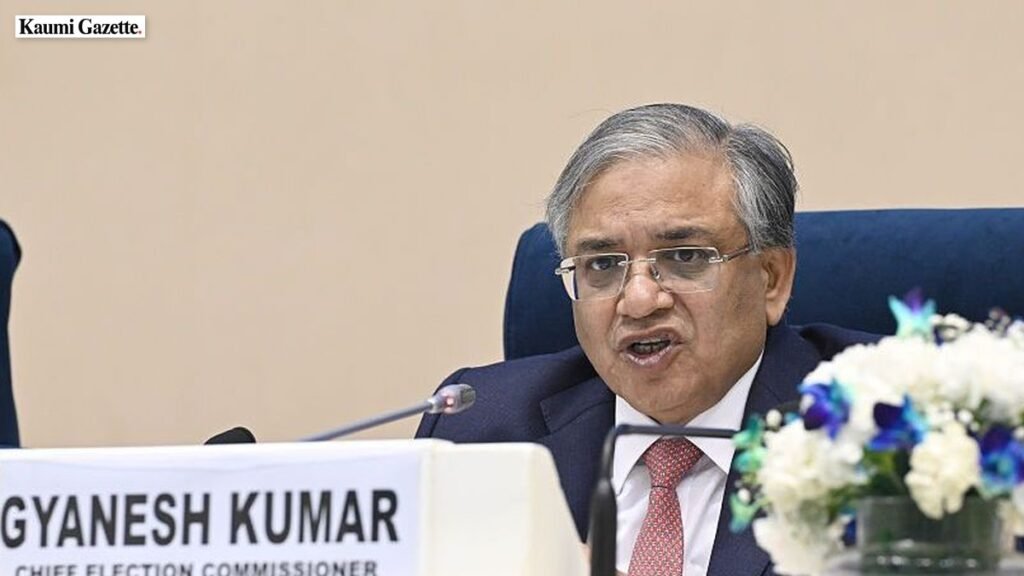
NEW DELHI — The legal challenges surrounding the appointment of Chief Election Commissioner Gyanesh Kumar and the 2023 Chief Election Commissioner and Other Election Commissioners Act deepened following a split verdict in the Supreme Court, setting up a decision by the Chief Justice of India on forming a Constitution Bench.
On September 23, 2026, Supreme Court Justices Dipankar Datta and Satish Chandra Sharma delivered divergent opinions on whether petitions challenging the constitutional validity of the 2023 Act should be referred to a five-judge Constitution Bench. Justice Datta held that a larger bench is unnecessary because a five-judge bench already established constitutional principles in the March 2023 Anoop Baranwal v. Union of India case, leaving only the question of conformity to be examined. Justice Sharma, however, favored referring the matter to a five-judge Constitution Bench due to the broader significance of the constitutional questions.
The controversy centers on the statutory framework governing top poll panel appointments. Parliament enacted the Chief Election Commissioner and Other Election Commissioners (Appointment, Conditions of Service and Term of Office) Act in December 2023. Under this legislation, Chief Election Commissioner Gyanesh Kumar and Election Commissioner Sukhbir Singh Sandhu were appointed in March 2024. Gyanesh Kumar subsequently assumed charge on February 19, 2025.
The legislation replaced a system where appointments were made directly by the President on government recommendations. It also diverges from the interim arrangement ordered by the Supreme Court in March 2023, which directed that appointments be made on the recommendation of a committee comprising the Prime Minister, the Leader of the Opposition in the Lok Sabha, and the Chief Justice of India. Under the 2023 Act, the selection panel instead comprises the Prime Minister, the Leader of the Opposition in the Lok Sabha, and a Union Cabinet Minister nominated by the Prime Minister.
Legal experts and petitioners have raised significant concerns regarding the structure and immunities provided under the 2023 statute. According to petitioners, the inclusion of a Cabinet Minister alongside the Prime Minister ensures that the selection panel perpetually leans toward the executive due to the government’s majority. Adhir Ranjan Chowdhury previously recorded his dissent regarding the appointments made by the selection committee.
Constitutional experts have also criticized Section 16 of the 2023 Act, which grants the Chief Election Commissioner and Election Commissioners protection from civil or criminal court action, or the continuation of proceedings, for acts done in the discharge of official duties. PDT Achary, former Lok Sabha Secretary-General and constitutional expert, stated that the law presents two major structural problems by tilting the selection panel toward the government and granting officials lifetime immunity from legal proceedings.
The statutory dispute has coincided with intense political friction. Opposition MPs passed an informal “people’s impeachment” motion against CEC Gyanesh Kumar amid protests over alleged errors and irregularities in the Special Intensive Revision (SIR) of voter lists, accompanied by demands for his resignation. Formal notices for impeachment motions submitted by the opposition in April were rejected by both the Lok Sabha and Rajya Sabha, while a second attempt remains pending in the upper house.
The matter now awaits the intervention of the Chief Justice of India, who will determine the constitution of an appropriate bench to resolve the split verdict and adjudicate the pending petitions against the 2023 Act.
Related stories



More from Explainers
 ExplainerFaculty Shortages and Equipment Gaps Strain Uttar Pradesh Medical Colleges
 ExplainerDeadly crowd surge at Kolkata Durga Puja pandal leaves nineteen dead
 ExplainerSupreme Court to urgently hear NEET candidate plea on NTA record retention rule
 ExplainerElection Commission Faces Credibility Crisis Amid Internal Friction and Controversies Over Electoral Roll Revisions
 ExplainerSpecial Intensive Revision of Electoral Rolls Deletes Millions of Voters Across States and Union Territories
 ExplainerReserve Bank of India raises repo rate by 25 basis points